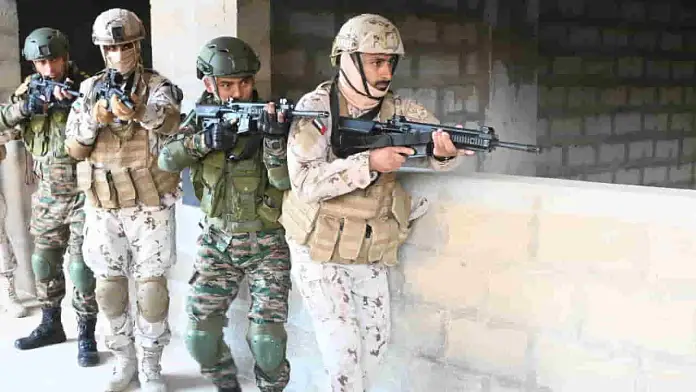
Al Hamra (UAE) | The armed forces of India and the United Arab Emirates (UAE) are currently engaged in Exercise Desert Cyclone–II in Al Hamra, sharpening their preparedness for urban warfare operations amid realistic desert conditions. The joint military exercise has reached a crucial phase, with troops from both nations undertaking intensive training in built-up areas to enhance interoperability and operational synergy.
Running from December 18 to December 30, 2025, Desert Cyclone–II is the second edition of the bilateral exercise. The first edition was conducted in 2024 at the Mahajan Field Firing Range in Rajasthan, India.
Focus on Urban Combat
Modern conflicts are increasingly being fought in urban environments rather than open battlefields. Keeping this in mind, the current edition of Desert Cyclone places special emphasis on urban combat techniques, including room intervention, building clearance, cordon-and-search operations, and neutralising hostile elements while minimising civilian casualties. Special attention is also being given to the detection and handling of Improvised Explosive Devices (IEDs).
Platoon-Level Joint Operations
The training has been divided into classroom-based interactions and field-level practical drills. Initially, soldiers from both sides exchanged operational experiences and tactical doctrines, which were later implemented during ground exercises. Troops are being trained in platoon-level joint operations, standard operating procedures (SOPs), and coordinated manoeuvres in complex urban settings.
Casualty Evacuation and First Aid
Recognising the challenges of casualty management in urban warfare, the exercise includes focused training on first aid, battlefield medical response, and casualty evacuation (CASEVAC). Soldiers are being trained to provide immediate medical assistance under fire and safely evacuate injured personnel to secure locations.
Drone and Counter-Drone Operations
The integration of drone and counter-drone technologies has added a new dimension to the exercise. With drones increasingly being used for surveillance, intelligence gathering and attacks in urban warfare, both armies are jointly training to detect, jam and neutralise hostile drones—skills considered vital for future conflicts.

Al Hamra: A Realistic Training Ground
Al Hamra is one of the UAE’s most advanced military training facilities, featuring a mock urban cityscape with buildings, towers and road networks designed to simulate real-world combat scenarios. Situated in a desert environment, it provides ideal conditions for training in both urban and desert operations.
Participation from Both Nations
India is represented by 45 soldiers from the Mechanised Infantry Regiment, who are experienced in operating BMP-2 infantry combat vehicles and conducting operations in urban and desert terrains. The UAE Army is participating with troops from its 53rd Mechanised Infantry Battalion, ensuring balanced and effective joint engagement.
Strengthening Strategic Ties
Unlike the first edition, which focused on cordon-and-search operations, heliborne missions and joint surveillance centres, Desert Cyclone–II is entirely centred on realistic urban warfare training. The exercise reflects the evolving security challenges faced by both nations and underscores the growing defence cooperation between India and the UAE.
Defence experts say such joint exercises not only enhance military readiness but also strengthen strategic trust, making them crucial for counter-terrorism operations, peacekeeping missions and stability operations where coordinated action between friendly forces is essential.